Wednesday, 15 March 2017

How does International Trade help increase employment and GDP of the country?


What is international trade?

International trade is the exchange of goods and services across international borders or territories.


How does international trade help increase GDP ?

Let us take a simple example as usual.

Let us consider India and china both produce oranges and phones.

If all resources are used then India can produce either 100 oranges or  50 smart phones. And China can produce 100 oranges or 150 smart phones.

This means if India decides to produce only oranges then it has to move all its resources to produce orange so that no resource is left to produce phone. But if India produces 50 oranges then it can produce 25 smart phones.
Same is true for China.

So what is the good option for India?

Is it good to produce 50 oranges and 25 smart phones or is it beneficial to produce only smart phones ?

Let us examine it for India.

100 oranges = 50 smart phones.

Hence,

2 oranges = 1 smart phone , or
1 orange = 0.5 smart phone

What does above equation mean?

This means if India produces 2 oranges then it can not produce 1 smart phone or visa-versa.
Or this means to produce 1 orange india needs to give up producing 0.5 smart phones.

For China:

100 oranges = 150 smart phones, or
0.66 orange = 1 smart phones or
1 orange = 1.5 smart phones.

This means to produce 1 orange china needs to give up producing 1.5 smart phones.

Suppose cost of 1 smart phone is 100 then cost of producing 1 orange in china would be 150 rupees while that of in India will be 50 rupees.

So china should always invest its resources in producing smart phones and india needs to produce oranges.

This way both can use their resources efficiently. In the end , because they are using their resources effectively, cost of production goes down. India can trade oranges for smartphones with China. By this way, consumers in both the countries will benefit from low prices of oranges as well as smart phones. This ultimately will increase consumption and help increase the GDP.


India's story:

Indian IT sector grew multifold when India opened up its economy in 1991 for global trade. Many people got jobs and standard of living has gone up since then. 

In early 90s average monthly income of middle class family  used to be around 3000 to 4000 rupees. Today , urban  younger generation spends 3000 to 4000 Rs. to buy Reebok or Nike shoes. Enormous wealth has been created and people's standard of living has been uplifted though many things need to be done for people who are still poor.


Sprouting Jingoism :

In today's era , Jingoism is on the rise. Donald Trump's presidential victory and phenomena such as Brexit exemplifies the Jingoism. Politics is trying to play with the people's emotions for their own agenda. 

Because of these events , global trade is under threat. This will bring down the international trade and global GDP. 

This will not only hurt the India and similar countries but also the countries which are trying to go back to  their shells and to isolate themselves from globalization.


Saturday, 17 September 2016

How come Apple Inc. is so profitable?


Many of us think how come multinational companies like Apple Inc. etc earn huge amount of money. No doubt Apple has very successful products such as iPhone, iPad , iPod and Macintosh computer etc.

But is there anything else that needs to be unearthed?

Let us see how some of these unknown facts thorough a simple example as always.

Let's assume a parent company "P", which has headquarters in Ireland and a subsidiary company "S", which operates in USA.

Tax rate in USA is 30% and that in Ireland is 10%.

The company is in the business of making and selling phones.

Let's assume the market price of the phone in USA is 1000 $ and the cost of manufacturing is 500$.

So if company S sells a phone, it gets a profit of 500$ and it will pay 30% of 500$ tax i.e.150$  to US government.


Everything is fine till now.

But now company P plays one fine trick to earn more money.

Company P tells company S , " You buy phone from us for 900$ and sell in USA for 1000$"

By this transaction profit of company S becomes 100$ and tax that S pays to US government becomes 30% of 100$ i.e. 30$.

Company P sitting in Ireland earns 400$ profit after subtracting 500$ manufacturing cost.

Company P now pays 10% of 400$  i.e. 40$ as tax to Irish government.

In total company has paid 70$ tax. Earlier it used to pay 150$ in taxes.

This is how company saved 80$ per phone.If company sells billions of phones per year it will save billions of dollars.

Moral or legal:

These kind of transfer pricing mechanisms are perfectly legal. But whether they are moral is the question that needs to be addressed.

Many of these big companies lobby in the government and bend the lawmakers in their favor by paying huge sums of money to lobbyist and many big shot legal firms.

So these companies get to decide the market power.

As small companies do not have enough money to shell out, they have to pay huge sums of taxes and eventually they will either become bankrupt or be bought by big companies.

Healthy competition is the only thing that benefits all the stakeholders. But by killing competition these companies are ultimately killing new ideas and consumer benefits.


Sunday, 24 January 2016

Net neutrality and economics of free internet.....


What is net neutrality? 

In net neutrality, Telecom service provider gives equal importance to all web data that is generated on the internet.

It is like rationalizing the bandwidth so that each and every website will load on the web browser with equal bandwidth.

It is like giving equal opportunity to each website.


Why net neutrality is so important?

Let us take a simple example.

Let us assume there are two factories 'A' and 'B' in the town which produce orange juice.

Factory A has huge amount of money at its disposal but factory B is not that rich.

Now, assume that these factories are far outside the town.

Juice can be transported from factory to town by a truck service provider 'C'.

Truck service provider is the only transport provider in the region. So factory 'A' and factory 'B' have to depend on 'C'.

Everything is going on well for now.

But suddenly owner of factory 'A' says to 'C', " I will give you the money and in the favor you should use all your trucks to transport my product in the town."

Due to this business strategy, factory B will go bankrupt after some time as it can not sell its product in the market.

Ultimately, because of money power, factory 'A' won the battle even if product of factory 'B' was superior to that of factory 'A'.

In the similar way, in the digital world, factories are like websites such as Facebook , Google etc.

Transport service provider is something like telecom operators.

So if a big and rich website company  gives free service to people by paying huge amount to telecom operators, then people will use only these websites.

So in a first place itself competition gets killed even if the competition has better product offering.

If company like Amazon had provided huge money to telecom service provider then Flipkart would not have been established.

So if there had not been a competition consumers like us would not have enjoyed low priced mobile phones, computers and so on.

So the internet service provider needs to be unbiased and neutral.

According to Adam Smith, father of modern economics, "COMPETITION AMONG PEOPLE MAKES BETTER PRODUCTS."


IF YOU LIKE MY BLOG PLEASE SHARE AND SUBSCRIBE


Tuesday, 19 January 2016

Is 20 $ per barrel price of oil good for economic growth of India and the world?


Why oil price is so low currently?
Price of any commodity depends on supply and demand.
If we see the current  global economic scenario then we can get the feel for why oil prices have gone down so steeply.

Majority of oil is consumed at following locations in the world

1. United states of America and Canada ( GDP 19 trillion dollars)
2. Europe (GDP 19 trillion dollars)
3. China (GDP 11 trillion dollars)
4. Japan (GDP 4 trillion dollars)
5. UK (GDP 3 trillion dollars) 
6. India (GDP 2 trillion dollars)

Oil is very important commodity for any country's economic progress.
So we can directly correlate economic growth to the price of oil.

China ,Europe, Japan and majority of countries around the globe are experiencing recession.

This means they need less oil for their economic activities.

World's 50 to 60 % oil is consumed by China.

We know from all the news channels, Chinese economy has slipped to 6% growth rate from double digit.

This lack of demand has pushed the price of oil down to huge extent.

Moreover, USA produces oil from shale gas at the production cost of 50$ per barrel

Saudi Arebia and other OPEC (Organization of Petroleum Exporting Countries) countries produce oil at around 20 to 30 $ per barrel.

In order to drive American oil producers out of business, OPEC started to supply more oil so that oil price will go down and  it would be unprofitable for non OPEC countries to produce oil.

These are ce​rtain macroeconomic and strategic factors  that are driving down the price of oil.


How does this matter to India and world?

India's major import is oil. It imports around 300 billion dollars worth oil every year.

If oil price goes down, we will have to pay less money in foreign exchange.

This reduces our current account deficit.

Due to small current account deficit, Indian rupee will appreciate. This is explained in my previous post as follows
http://isheconomist.blogspot.in/2015/12/how-does-current-account-deficit.html

Due to rupee appreciation, Indian export sector will get badly affected. India's major exports are software, jewelry etc.

As Prime minister of India is promoting 'MAKE IN INDIA' project , appreciation of currency may not be helpful for the project.

Indian companies also export engineering goods to OPEC countries. This will also get affected.

Many Indians (especially Kerala people) work in Saudi, Oman , Kuwait etc. and send remittances to Indian coffers. It will be difficult for these people to find jobs.

So in a short term, in my opinion, India can enjoy low price of oil and come out of recession very quickly. But in a long run low price of oil is not good for economic growth of whole world and India.Due to globalization all the economies are  integrated in each other.

It is no more a solo dance but a line dance.  So if we want everybody to be better off then , oil price needs to be at optimum level.


Saturday, 5 December 2015

How does current account deficit affects common man?


What is current account deficit?

Current account deficit is the difference between value of import and value of export.

If a country X exports goods and services worth Rs. 100 but imports goods and services worth Rs. 120, then there is difference or deficit of Rs. 20.

How does current account deficit can create a problem?

Let us take an example of India.

India imports oil from Saudi Arabia and exports softwares to USA.

Let us assume,  price of 1 barrel of oil = 1 dollar = 1 Rupee


Let us assume India imports 100 barrels of oil each year. So it has to pay 100 dollar i.e. 100 Rupee.

So , Price of 100 barrel of oil = 100 dollars = 100 Rupee

India exports 100 Rupees worth softwares. So it earns 100 dollars.

So India can pay its oil bills every year comfortably.

Now, assume in some year software requirement from USA becomes 50 dollars. Thus India gets only 50 dollars from exports. So India has to sell 100 Rupee worth software for 50 dollars.

50 dollars = 100 Rupees. So Indian currency becomes 2Rs/dollar. 

This shows currency depreciates whenever there is a trade deficit.

So India now has to pay 200 Rupees for 100 barrels of oil. Thus imports become costly.

As the import becomes costly inflation will happen because transportation costs will go up.This will increase prices of cement steel etc.So housing prices will go up.

In order to bring down this inflation RBI has to increase the REPO-RATE. Effect of repo rate has been discussed in the following blog post.

http://isheconomist.blogspot.in/2015/11/what-is-repo-rate-how-does-it-affect-me.html

Due to increase in Repo rate business will get loans at higher rate. So businesses will be reluctant to expand. So less number of jobs will be created.

Depreciation can also make foreign debts very costly. For explanation read following post
http://isheconomist.blogspot.in/2015/10/how-depreciation-of-currency-can-create.html


IF YOU LIKE MY BLOG PLEASE SUBSCRIBE AND ENJOY LEARNING ECONOMICS.

My twitter handle is @ishaeris123


https://twitter.com/ishaeris123/status/719069650277896192


Thursday, 26 November 2015

Name is BOND...... GORVERNMENT BOND


In order to understand Government Bond we need to understand fiscal deficit.

What is fiscal deficit?

Let us assume government wants to spend 100Rs. But government earns 98 Rs. through tax that we and corporates pay.

Thus government has 2 Rs less than it requires.

Thus government has fiscal deficit of 2% .

But why does Government needs extra money?

Government needs money to spend for following purposes
  1. health-care
  2. Education (schools etc)
  3. Roads
  4. Railways
  5. Airports etc
All this public expenditure increases the Gross Domestic Product (GDP) of country. Read my following post for explanation.

From where does deficit is funded?
As government faces this fiscal deficit, government issues a bond.

Bond is nothing but a piece of paper that says ,"PLEASE GIVE ME SOME MONEY I WILL PAY YOU INTEREST"

WHO BUY THESE GOVERNMENT BONDS?
Following entities buy government bonds
1. People like you and me
2. Reserve bank of India
3. Foreign investors
4. Foreign governments
5. World Bank
6. IMF (International Monetary Fund) etc.

This government debt is funded through tax. And a common man pays this tax. That's why we call this debt as public debt.
If this debt is used for good purpose in order to create the asset, then GDP will increase and many jobs will be created.
But if it is used for various pongy schemes then it can create a problem. This is explained in my previous post as follows.
http://isheconomist.blogspot.in/2015/11/how-does-government-debt-affects-comman.html

If government takes loan at 3% interest rate and if economy grows at 6% then government can pay back this debt easily.


RECENT HAPPENINGS:
Recently Indian government has issued"RUPEE BONDS".

PM of India has urged Singapore investors in "INDIA-SINGAPORE ECONOMIC CONVENTION PROGRAMME" to buy these bonds so India can fund its infrastructure projects.


I hope this will certainly give boost to Indian economy.


IF YOU LIKE MY BLOG PLEASE SUBSCRIBE AND ENJOY LEARNING ECONOMICS.


Thursday, 19 November 2015

how does government debt affects common man?


Any economics related problem or phenomenon is related to supply and demand.

We know that, in any country government is the biggest borrower of debt.

Many times government spends more than its tax earnings.

What happens if government spends more than it earns?

So as usual, let us take a simple example.

Capital in any country is fixed. Central reserve bank can not print infinite amount of money as discussed in my previous post.
http://isheconomist.blogspot.in/2015/10/why-rbi-can-not-print-money-all-time.html?m=1

Let us assume amount of capital in the country is Rs 100.

This money is borrowed by following people or entities

1.       Corporate houses for their business
2.       People like you and me for home , car, TV etc

When government needs money for its various pongy schemes and unproductive operations , it raises money from market.

So demand for money will increase.

Businesses and common people won’t get enough money.

This in turn will increase the interest rate. And housing loans and car loans will become costlier.

So common man suffers if government has huge debts.

But what if government uses its debt and creates assets e.g. Roads , water dam and irrigation projects. To find out answer read my following blogpost
http://isheconomist.blogspot.in/2015/10/how-does-government-infrastructure.html?m=0


If you like my blog , please subscibe and follow by email and enjoy learning economics.

Thursday, 12 November 2015

How does FDI increase economic growth of the company or country?


What is FDI?
FDI means foreign direct investment in the form of physical assets or financial assets etc.

How does FDI increases growth rate of the country?
Let us assume there is only 1 bank in the country X.
Bank has 100 Rs. Capital.
There are two businessmen in the country.
Both of them need 70 Rs. to expand their businesses.
But capital available to them is just 100Rs.
So both of  these businessmen will fight to get 70rs. For their businesses.
As the demand for capital increases, bank will  increase the interest rate.
This increases cost of capital.

But if someone outside the country parks 40 Rs in country X, then bank in the country X will have sufficient funds to lend to businesses. 
So businesses don't have to compete for capital. 
Both businesses can expand creating jobs and economic growth.

RECENT HAPPENINGS:
In the recent time, government has reduced certain restrictions on FDI in 15 sectors in India.

I hope this will certainly give boost to the growth of Indian economy.

Saturday, 7 November 2015

What is Leverage effect of debt?


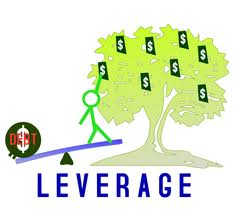
Leverage is the financial instrument in the form of debt , which companies use to increase their profitability.

Confused?

You might be thinking how taking debt can potentially increase the company's profits?

Let us take a simple example.

Let us assume a company which manufactures cars.

Company needs 100 Cr Rs. as an investment for its factory, land, machines etc.

Profitability of a company depends on its investments.

Company sells its products and makes a profit of 10% i.e. 10 Cr Rs.

Now the company takes loan of another 100 Cr. Rs. at interest rate of 7 %.

Now company has total investment of 200 Cr. Rs on which it makes a profit of 20 Cr. Rs.

Company pays bank  107Cr Rs. i.e. 100 Cr. principal and 7Cr interest.

Thus Company's profit on investment is 13 Cr. Rs on 100 Cr.Rs

Hence company made profit on investment of 13% instead of 10 % earlier.


What are the obstacles then?

1. If the economy is going through deflation then debt can really create a big problem. This was discussed in my earlier blog post
http://isheconomist.blogspot.in/2015/11/is-deflation-good-or-bad.html

2. If the REPO-RATE is high then company has to take loan at higher interest rate and hence  can create problem for a company. This was discussed in my earlier blog post
http://isheconomist.blogspot.in/2015/11/what-is-repo-rate-how-does-it-affect-me.html


How can I use Leverage Information?

If you want to buy shares of certain company then go to its balance sheet and check the amount of debt that the company has on its books.

Check what is the current REPO-RATE on RBI's website.

See the growth rate of the economy and growth rate of the industry in which company operates.

Using this information you can approximately predict the company's performance in coming years.

Then you can decide whether to buy the shares or not.


If you like my blog then please subscibe through email and enjoy learning economics.


Wednesday, 4 November 2015

what is repo-rate? how does it affect me?


what is repo-rate?

It is the interest rate at which the reserve bank of India gives loan to other banks. It is also called as repurchase rate.

But why does other banks need money?
We deposit all the our money in the bank.

Bank gives this money to businesses, to individuals etc. and earn profit out of it.

What if one of the depositor comes back and asks for money ? or Some businessman comes and asks for loan?

Now the Bank takes loan from Reserve Bank of India(RBI).

RBI charges certain interest on this amount . This interest is called as REPO-RATE.

Bank tries to give more and more loan to businesses and individuals.

If RBI charges 7% interest to bank then bank charges more interest to its customers. Let us assume bank charges 10 % to its customers and makes profit of 3%.


How does REPO-RATE affect me?
If RBI increases repo-rate then bank will also increase its lending rate to maintain its profitability.

So businesses and individuals will get loans at higher interest rates.

So businesses can not expand their factories etc. and individuals who like to buy homes will also suffer from higher EMIs. So they postpone their decisions to buy home.

As we can not increase supply of goods and services, they will become costlier to buy.

Because of this,  demand of goods will decrease and price will also fall.

This will bring down the inflation.

Thus RBI uses repo-rate as a tool to control inflation


Sunday, 1 November 2015

Is deflation good or bad?


What is deflation?

Deflation means fall in the prices of goods and services.


Isn't deflation good then?

We probably think that deflation is good as the prices are falling. But we are wrong.

Here is a good example. Let us assume a company which is manufacturing steel and selling in the international market.

Company operates and expands its operations by taking loan from banks.

Let us assume company takes Rs. 100 as a loan amount and pays 10% interest on it.

If the economy goes through deflation then the price of steel are going to fall.

This will reduce the revenue and profit of the company.

But, company still has to pay interest of 10% on its loans and has to pay to its workers.

This will again reduce company's profitability.

As the steel prices are falling, people ,who buy steel in the market, will wait for further fall in prices.

 This again puts pressure on the profitability of a company.

Company then fires its people and sell some of its plants in order to pay for its debt. 

If company fires its people then there is going to be unemployment. 

This will again reduce the demand for products and prices of steel will again fall.

This creates unending vicious cycle.


Recent happenings:

The example that I have mentioned is of TATA STEEL. In a recent time, they fired 1300 people from its U.K. division and sold some of its assets.

Japan is going through some serious deflationary cycle. Japanese government is trying hard to come out of this deflation. As the prices are falling, many auto companies in Japan are not investing because they think price will fall further. So no major economic activity is happening in Japan.


If you like my blog , please follow me at my twitter handle @ishaeris123

https://twitter.com/ishaeris123/status/718113299972251648


Wednesday, 28 October 2015

How does government infrastructure projects boost GDP ?


Let us take very simple case.

let us assume govt. has to construct a road for public utility.


Cost of a road project is Rs 100.

Expenditure of govt. will be income of somebody . Let us assume that somebody is person A.

Person A saves 20% and spends 80% of his income. This means person A saves Rs 20 and spends Rs. 80.

Here is the interesting part now.

Expenditure of person A will be income of , let us assume, person B.

Person B also saves 20% and spends 80% of his income. This means he saves Rs. 16 and spends Rs. 64.

Expenditure of person B will be income of person C so on and so forth.

As we know that all the expenditure happened in this case will be counted in GDP of a country.

So GDP= 100+0.8 x 100+0.8 x 0.8 x 100 + ...

This is a geometric series and hence total GDP = 100/0.2= 500


So if govt spends 100 Rs on a project  then GDP increases to 500 Rs.

This called a multiplier effect in economics. In this particular case multiplier is 5.

If you like my blog , please follow me on my twitter handle @ishaeris123

https://twitter.com/ishaeris123/status/718741811015987200


Why onion prices are so high in current time ( Supply side Inflation)?


How does inflation occur from supply side?

Price of any good or service depends on supply and demand of that good or service.
If supply of any good or service increase then price will decrease and vice a versa.

Following factors of production create inflation from supply side.


  • Industrial disputes between labor and management
            If there is a dispute between labor and management then strike will occur. this reduces the               output of a company. Hence supply of produce will go down and hence inflation will occur.


  • Shortage of factors of production:
           Man : why an engineer gets more salary than a worker?
 Because more workers are available to do less skillful job than engineers are . So shortage of   skilled labor creates dives up the salaries. 


          Machine: Why govt. gives subsidy to farmer to buy tractor? 
   Because if farmer uses tractor he will produce more crop. So supply of farm produce will increase and inflation can be controlled. So Lack of machine will give rise to inflation.

          Money: Why government banks such as SIDBI gives loan to farmers at very less interest rates? or why  Modi govt. has created a new bank, MUDRA? 

 Without money nobody will be able to buy machines or hire men to produce goods and services. MUDRA bank provides loans to small vendors such as small fruit vendor. A small fruit vendor uses his small cart to sell his fruits. Imagine if he buys a small 3 wheeler. So he can bring   his perishable items to market very easily. So he can sell more fruits in market increasing supply and reducing inflation.

        Material: Why price of gold is more than price of steel?

  As availability of gold is less than the availability of steel, supply of gold is less in the market. Due to this price of gold is very high or we can say that the price is inflated. This is supply side inflation. 


  • Natural calamities:
          Why El-Nino was so much in News few days back?

 El-Nino is a climatic situation in which Australia and India will face shortage of monsoon. The monsoon shortage affect India's agricultural produce. This will give rise to the inflation of food prices. Thats why India in the recent past was facing inflation of daily food items. Inflation level was around 10%. 


  • Black marketing creating artificial shortage:
          Why onion prices were so high in the recent time?


          Middle men or traders create artificial shortage due to which supply of onion in the market goes down and onion prices sky-rocket. 


Wednesday, 21 October 2015

why does share price of a company fluctuate in share market?

let's take a simple example.
let us assume a country called RICE-LAND.
everyone in this country eats only rice. Some farmers produce only rice.
In economics, price of any good depends on supply and demand.

Now, lets assume meteorological department of country predicts that there is not going to be enough monsoon this year. So people in this country will face food shortage in coming time. So people will go in market and purchase extra rice than they need . Thus they create extra demand and food price will shoot up.

Similarly, if meteorological dept. says that there is going to be enough monsoon  then rice price is going to be stable or will slightly go down. Because there will be enough rice in the market and people won't think that there is going to be a shortage in the near future.

Same phenomenon occurs in the share market. If people feel that due to certain market conditions company is going to make huge profit in the future then they start buying that share. Thus the demand of the share increases. And hence the price also increases.


Tuesday, 20 October 2015

Why RBI can not print money all the time & distribute to poor?


Here is a good example.
Let’s assume a country called RICE-LAND where everybody eats rice.
Cost of rice is Rs1/kg.
RICE-LAND produces 100 kg rice each year. Cost of production is Rs.100
What if the government decides to print money &  give its money to poor to eradicate poverty?
Because people get money, they will go and buy rice in the market.
So demand of rice will increase.
So the people who earn money by hard work won’t have enough rice to eat and price of rice will increase.
This explains how printing money will give rise to inflation.
Now what should the government do in this case?
Government in this case will actually give subsidy to farmers. Let us assume subsidy of Rs.10 to buy tractor.
Due to farm mechanization farmer will be able to produce extra 10 kg rice or more than that.
Now cost of production of rice is Rs.110 and crop produced is 110 Kg.
So still you got cost of per kg rice Rs. 1/Kg.
And economic activity in the country increased which we call as GDP.
This gives a pretty good example how subsidies increase the GDP of country and why RBI cant print huge amount of money and distribute.

How depreciation of currency can create problem for a company?


How depreciation of currency can create problem for a company


Due to globalization, multinational companies raise their loans in foreign currencies. So depreciation of currency will create problems to pay the loan.

 e.g. Let us assume company X in India has taken loan from some bank in USA in dollars. At the time of taking loan exchange rate was Rs.50 per dollar.

Due to certain macroeconomic instabilities, let us assume indian currency depreciated. Now the exchange rate is Rs. 60 per dollar.

So company has to pay more money now. 

So devaluation of currency brings potential ruin to companies that have borrowed in foreign currency.